How Much Does 2D Animation Cost and How Long Does It Take?
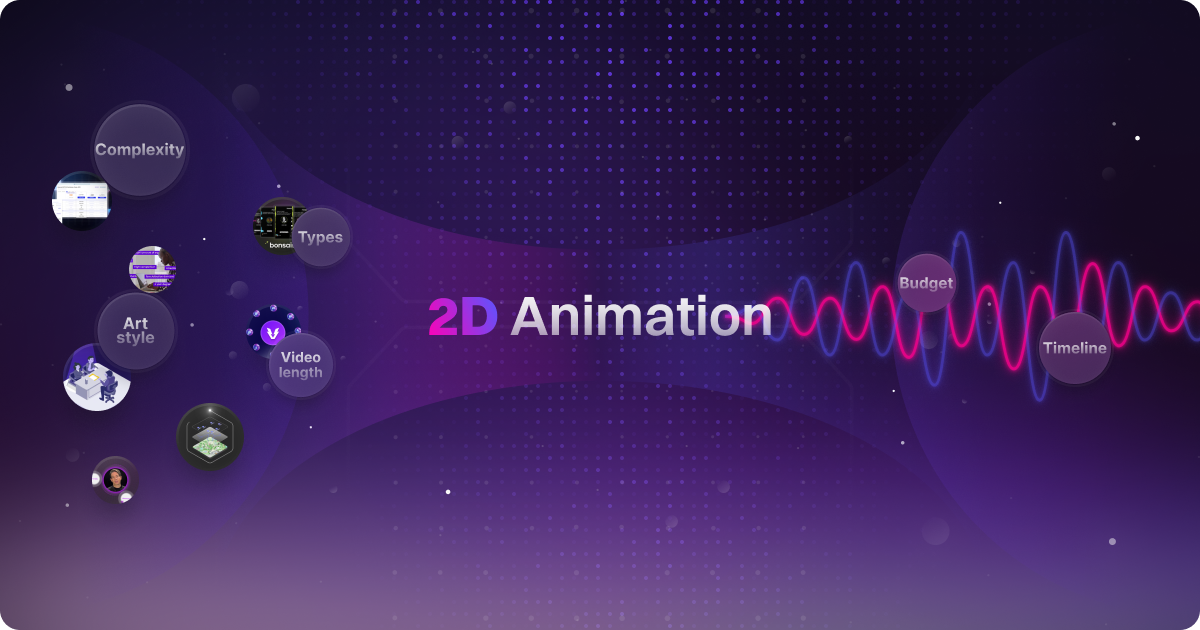

table of content
A startup marketing lead once told us she’d spent three weeks getting quotes for an explainer video and came away more confused than when she started. One studio wanted £12,000. Another quoted £800. Neither explained what the gap meant.
That gap is real, and it’s explainable. 2D animation pricing varies based on style complexity, studio overhead, revision rounds, turnaround speed, and whether you're commissioning a one-off or working on retainer.
Below, we break it all down from typical cost-per-minute benchmarks to the growing question of whether AI-generated animation is actually cheaper. Spoiler: it depends entirely on what 'cheaper' means for your brand.
TL;DR
- 2D animation typically costs £1,500–£8,000+ per finished minute, depending on style and scope.
- A 60–90 second SaaS explainer video usually falls in the £2,000–£6,000 range.
- Subscription models cut per-video cost for teams with regular output needs.
- AI animation tools are improving but lack the brand consistency and control of studio-produced 2D.
- The cost advantage of 2D comes from reusable assets, predictable pricing, and no hidden rework loops.
What does 2D animation cost?
If we are being honest, there is no single right answer to this question; there are aspects of how 2D animation is typically priced, such as:
Cost per minute
A professionally produced minute of 2D animation typically ranges from $1,950 - $10,400+, depending on the complexity of the style, the studio's location, and the project scope. Simpler motion graphics, such as icon animations or basic UI transitions, fall at the lower end, requiring less custom work and quicker production. These are ideal for explainer videos or informational content.
On the higher end, more complex animations like character-driven narratives with custom illustrations, lip sync, and detailed motion increase the price. These projects require more time, expertise, and a larger team, making them great for brands looking to tell a story with deeper visual impact. Additionally, the studio's location and the project scope, including the number of scenes or revisions, also affect the final cost.
Cost per project
Most SaaS explainer videos are 60–90 seconds long, with typical project budgets ranging from $2,600 to $7,800 for a capable studio. Studios in this range can deliver high-quality work and a solid final product, but agencies with higher overhead or premium brand credentials may charge more.
Freelance platforms generally offer cheaper rates, but they often lack the ability to maintain brand consistency across multiple assets. This can be a challenge when you need cohesive, high-quality content for your brand over time.
Subscription vs one-off
If your team needs regular video output, such as monthly social content, product demo updates, or onboarding flows, a subscription model can significantly reduce the cost per video compared to commissioning one-off projects. By committing to ongoing production, you gain more flexibility and value over time.
At Motion The Agency, we offer subscription-based retainers designed specifically for ongoing SaaS and tech marketing needs. This approach ensures consistent video quality and brand alignment across all content, making it ideal for brands with regular video demands.
Variables that affect the price
okay now that we talk about the pricing model, let’s talk abbout other aspects that could increase or decrese the pricing of your 2D video project:
- Style Complexity: Simple flat designs are cheaper, while character animation with detailed designs and movements costs more.
- Number of Revision Rounds: More revision rounds increase the price, especially if additional changes are requested after the initial rounds.
- Voiceover, Music Licensing, and Sound Design: Including a professional voiceover, licensed music, or custom sound design adds to the overall cost.
- Turnaround Speed: Faster delivery or rush orders typically incur additional fees for prioritizing the project.
- Studio Location and Overhead Structure: Studios in higher-cost areas or with larger teams may charge more to cover their expenses.
2D animation cost breakdown
We've already done a full cost analysis on marketing videos, so think of this article as a follow up. This time, we're zooming in on 2D animation and what really goes into the price tag. To see how 2D compares to other animation styles and production methods, check our explainer video cost breakdown
If you’ve ever Googled “how much does a 30–60 second 2D animation cost,” you’ve probably seen answers all over the place. Some say $5,000–$30,000, while others throw out numbers as high as $100,000–$500,000. Pretty wild for such a short video, right?
Here’s the thing. On average, a 2D animator makes about $39 an hour this also vary depending on the experience they has. Most studios say a 1-minute video can take anywhere from 3 to 8 weeks to produce. If one person handled everything from script to final render, that alone would come out to around $7,800. But that’s not the reality. Real projects usually involve more than one animator, plus scriptwriters, storyboard artists, project managers, and editors. On top of that, you’ve got software subscriptions, tool costs, and revisions that add up quickly.
Who you hire also makes a big difference:
And it doesn’t stop there. The final cost also depends on things like the art style, animation complexity, length of the video, production timeline, number of revisions, and even where the team is based.
So while the finished piece might only be a minute long, a lot of people, time, and tools go into making it happen. That is what you are really paying for: the expertise and the process, not just the minutes on screen.
2D animation timeline breakdown
Just like cost, the timeline for producing a 2D animation can vary a lot depending on the style, scope, and resources. On average, creating a professional 1-minute 2D animation takes anywhere from 80 to 300 hours of work. That can stretch across a few days or several weeks depending on what you are trying to achieve.
The style of animation is one of the biggest factors. Frame-by-frame animation is the most time-consuming since every single frame needs to be drawn. Projects like this often take weeks or even months. Motion graphics, on the other hand, are much faster since they rely on shapes, text, and transitions. In some cases, a simple motion graphic can be produced in just 2–3 working days (this excluding storyboarding and script writing).
Other factors that play a big role include:
- The skills and experience of the animators
- The size of the team working on the project
- The tools and software being used
- The overall level of detail in the design and animation
So while some projects can be completed in days, others may take months. The key is to align the animation style and production resources with the goals of the project to get the right balance between speed and quality.
So, how does Motion The Agency works fast while staying on budget?
The simple answer is that we’ve built a strong, reliable workflow that keeps our team from feeling overwhelmed or burnt out, while still delivering high-quality projects on time.
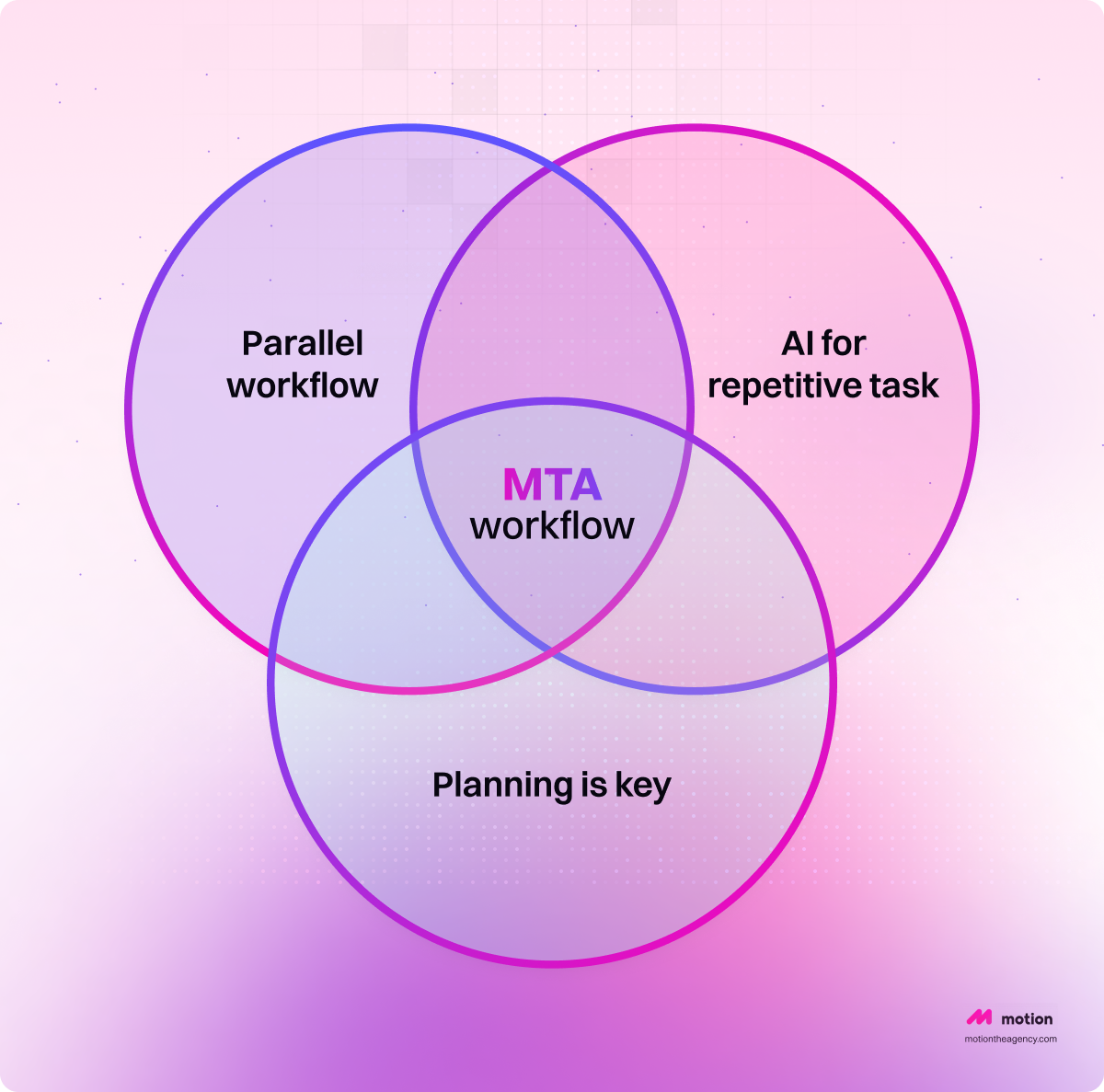
The longer answer is that this didn’t happen overnight. We’ve worked hard to create a well-oiled system by testing different tools to boost productivity, setting up strict quality checkpoints for every project, and learning from trial and error over the years. The workflow we use today is the result of our experienced team refining the process again and again until we perfected it. But here are a few ways we can managed this.
Parallel workflow
When we take on complex projects, we like to set up parallel workflows. That means two or more animators can work on different scenes at the same time. It helps us move faster without losing quality, since everyone can focus on their part while still following the same overall style.
And it’s not just the animation stage where we do this. In 2D projects, we also run scriptwriting and storyboarding in parallel, so by the time animation starts, there’s already a solid foundation in place.
The best part is that once someone finishes their piece, they can jump onto another task or even another project. That way, we keep things moving, save time, and make sure no one is sitting idle while waiting for the next step.
AI for repetitive tasks
2D animation can often be more time-consuming than expected. For example, with human characters, we might spend hours searching through stock photos for the perfect reference or write complex scripts in After Effects just to handle repetitive tasks. This is where AI tools come in handy.
As we mentioned in our Klutz review, we use AI to streamline those time-consuming processes. It is great for quick scripting, automating small tasks, and helping us test ideas fast. Tools like MidJourney and Kling AI also assist with generating references and mockups, helping us set a visual direction quickly. With AI handling the repetitive tasks, our team can focus more on the creative details that make the animation stand out.
That said, AI video tools like Runway, Pika, and Kling have matured and are now capable of producing short video clips from text prompts. Some marketing teams are even using them for social content. But does that make traditional 2D animation obsolete?
Not quite. AI-generated animation still struggles with consistency across frames, accurate depictions of UI or brand characters, controlled narrative pacing for explainer videos, and the professional-grade polish required in B2B and SaaS contexts. While AI tools are inexpensive for experimentation, achieving brand-quality results still requires significant human input for editing, iteration, and post-production.
In contrast, 2D animation from a studio offers locked-in brand style consistency, approved storyboards, consistent characters and assets, and predictable turnaround. For anything customer-facing or brand-defining, professionally produced 2D animation remains the more reliable and often more cost-efficient choice when you factor in revision rounds and rework.
Planning is key
Before we even start production, we always have an initial chat with the client to get aligned on goals, style, and the overall approach. That way, everyone’s on the same page from day one and we avoid surprises later. This includes, budget planning, we have a free cost calculator that could help you get an estimation for your next project!
Once the project kicks off, we keep communication open at every stage. Each step has its own quality check, so we can catch small issues early instead of dealing with big revisions at the end that would eat up time and budget. Clients are fully involved in this process too. We use tools like Figma and Frame.io, which let them drop comments directly on designs, storyboards, or video drafts.
This way of working keeps everything moving smoothly. Feedback comes in quickly, our team can make adjustments right away, and quality stays consistent without the stress of last-minute changes.
Conclusion
So if you ask us, “how long does it take to create a 2D animation and how much does it cost?”
For us, a 2D video typically costs between £2,700 and £5,200, with a timeline of about 4 to 14 working days, not including revisions. Of course, the bigger answer is that it really depends on what you’re looking for. A detailed, intricate animation will naturally take more time and budget, while a simpler piece can be produced faster and at a lower cost.
At Motion The Agency, our goal is always to find the right balance of speed, budget, and quality so that the final animation is not only engaging but also effective in achieving your goals. Every project is a little different, which is why we put so much focus on planning, communication, and quality checks along the way. That way, you get results that look great, perform well, and arrive on time.
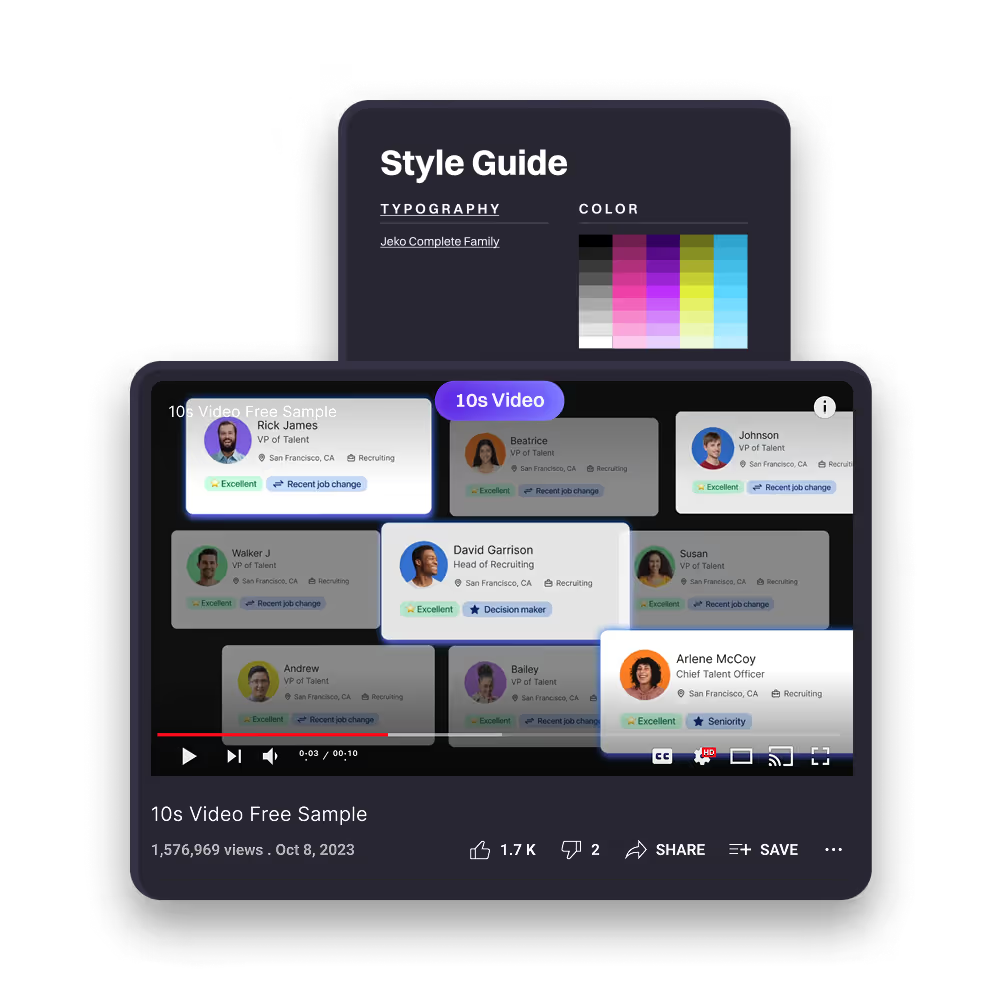
If you are considering a 2D animation project and are unsure where to start, let’s talk. Book a call with us, share your ideas, and we can walk you through what is possible. We even offer a free sample so you can see firsthand how our approach fits your needs before committing.
FAQ

Widi Setyowati
Widi is a content marketing specialist with experience in video marketing, email marketing, and content creation. At Motion The Agency, she specializes in crafting engaging video campaigns, impactful email outreach, and insightful written content.


Syarafina Kuswahyuni
Syarafina Kuswahyuni is a digital marketer specializing in content marketing and social media management, with expertise in content planning and strategizing.
In just a few questions, get a tailored estimate for your next video project.


Contact Us
Ready to elevate your brand? Contact us for your
Free Custom Video Sample